|
Here's a general synopsis of how a boost controller works, since it'll help you understand why you don't need a seperate wastegate.
As you know, a wastegate opens at a predetermined boost level (usually set by some sort of spring/diaphram contraption). When it opens, it lets exhaust past through it instead of through the turbo, limiting the RPM's of the turbo, thus limiting the boost it makes.
For this discussion, we'll focus on manual boost controllers, since electronic ones work a bit differently.
There are two types of manual boost controller, ball and spring and bleeder types. With ball-and-spring types, a spring-loaded ball is used to block this delivered boost "signal", until the desired boost level is attained. It is at this point, that the delivered boost pressure is strong enough to push the spring-loaded ball toward the spring and out of it's seat, allowing the signal to pass, and reach the Wastegate Actuator. The MBC is adjusted by turning a knob (or other adjustor), which varies the load on the spring inside the MBC. By adjusting it so there is more load on the spring, you are 'raising the boost" because more boost pressure is required to move the ball off its seat before the signal can pass to the Wastegate Actuator. By contrast, lessening the load on the spring allows the boost signal to more easily unseat the ball and continue on its voyage to the Wastegate Actuator, so by backing the adjustor away from the spring, you are "lowering the boost"
With bleeder types, a valve simply "bleeds" off some of the boost pressure that it receives. It always allows some boost pressure to reach the Wastegate Actuator, but the boost pressure that the Wastegate Actuator receives is always less than the level of boost pressure in the charged portion of the intake system (or the boost level delivered to the bleeder-type valve) because this kind of MBC basically is a controllable boost leak. Since the Wastegate Actuator does not receive the "full boost signal", it only opens the Wastegate when the amount of boost that gets past the "leak" is sufficient to force it open. The bleeder-type MBC is adjusted by changing the size of the leak. Closing the leak down lowers boost level, because more of the boost signal then reaches the Wastegate Actuator, opening the Wastegate sooner. Opening the leak wider raises the boost level, as more boost is released to the atmosphere, as opposed to being delivered to the Wastegate Actuator as a boost signal; so the opening of the Wastegate is delayed.
Hope this helps,
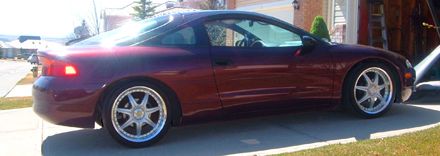
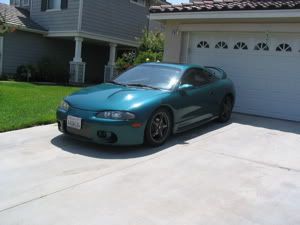
Brian Red 97 Eclipse GS (420a) MTX
Custom Garrett T3 Turbo system
Megasquirt w/52 lb/hr injectors & a Walbro 255
Kicker/Alpine Audio (3 amps, 2 subs)
90 Cav 2.2 TBI auto (winter) <- yeah, it's fast
|

 Search
 Printer-friendly copy
 1 User in Chat